South Dakota Opens $12 Million Opioid-Settlement Funding Portfolio for 2027
South Dakota has announced a $12 million FY2027 opioid-settlement funding portfolio covering treatment, recovery, prevention, infrastructure, justice-impacted populations and local needs.
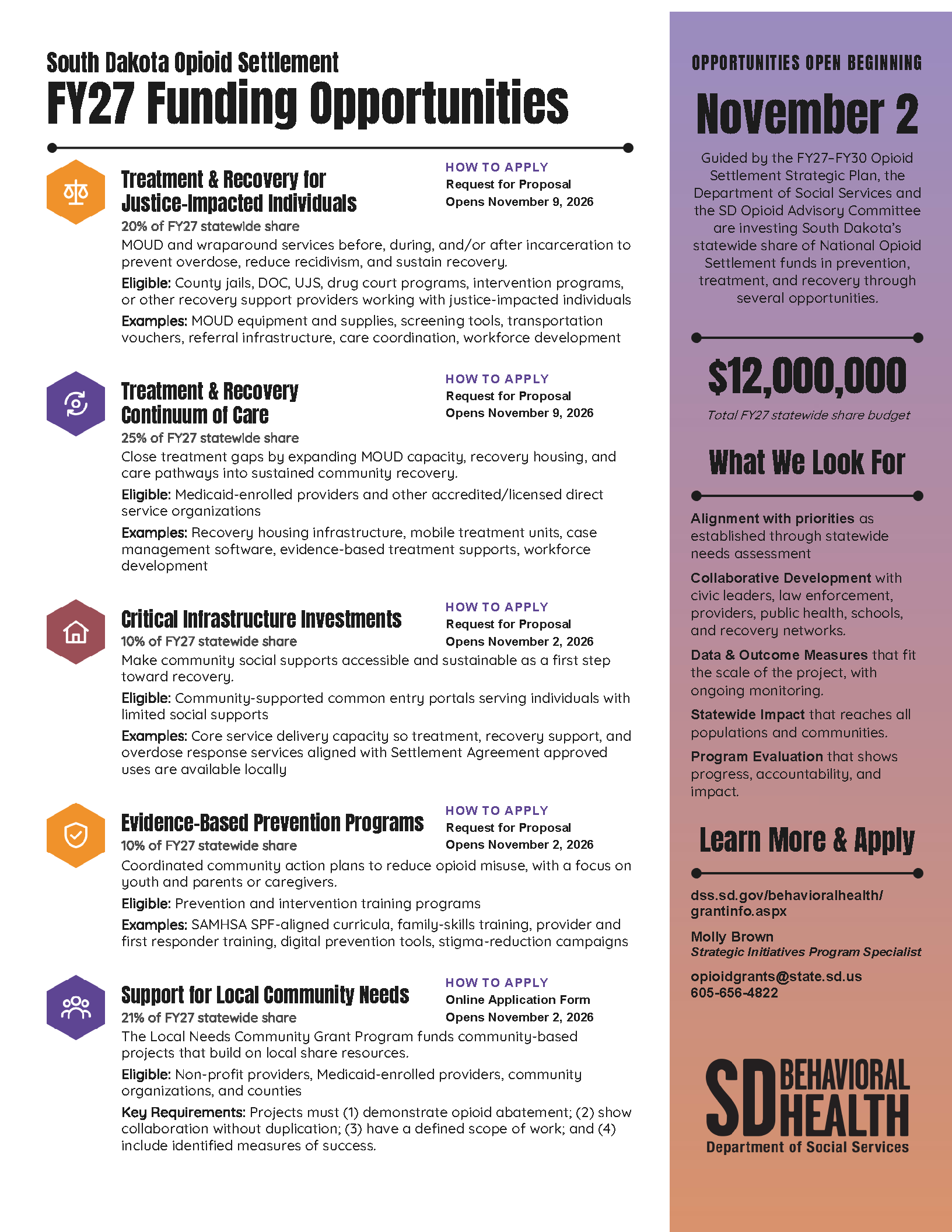
South Dakota has opened a series of opioid-settlement funding opportunities supported by a $12 million fiscal-year 2027 statewide-share budget.
The announcement represents planned grant and procurement opportunities—not $12 million in completed spending or finalized awards. That distinction should remain clear in public reporting and in ARP’s Opioid Settlement Spending Tracker.
The state’s published opportunity sheet identifies five major categories.
Twenty percent of the statewide share is designated for treatment and recovery services serving justice-impacted individuals. Eligible applicants may include county jails, correctional programs, drug courts and recovery-support providers. Examples include medication for opioid use disorder, screening, care coordination, transportation and referral infrastructure.
Twenty-five percent is designated for the treatment and recovery continuum. The state identifies recovery housing, mobile treatment, case-management technology, workforce development and evidence-based treatment support as possible uses.
Ten percent is allocated to critical infrastructure intended to make treatment, recovery support and overdose-response services more accessible and sustainable.
Another 10 percent is directed toward evidence-based prevention, including youth and family programming, provider training, first-responder education, digital prevention tools and stigma reduction.
Twenty-one percent is identified for local community needs. Applicants must demonstrate opioid abatement, collaboration, a defined scope and measurable results.
Those five categories account for 86 percent of the stated statewide budget. The one-page opportunity summary does not assign the remaining 14 percent to an additional category. Applicants and residents should consult the full strategic plan, individual requests for proposals and future award announcements before assuming how every dollar will be used.
Some opportunities opened November 2, while the justice-impacted and treatment-continuum requests were scheduled to open November 9.
The funding framework emphasizes collaboration and outcome measurement. That is important because opioid-settlement spending can become fragmented when multiple organizations launch overlapping projects without a coordinated referral system.
South Dakota’s large rural geography also creates special implementation challenges. A program may appear statewide on paper while remaining difficult to reach for people who lack transportation or live hours from a provider. Mobile services, telehealth connections, transportation support and regional referral networks can therefore be as important as the number of programs funded.
Why This Matters
This portfolio addresses several different stages of the opioid crisis rather than placing the full budget into one intervention. Treatment, prevention, recovery housing, transportation, justice-system transitions and infrastructure can reinforce one another. The challenge will be converting broad funding categories into accessible services with measurable community results.
Addiction Recovery Pro Perspective
Addiction Recovery Pro supports South Dakota’s emphasis on collaboration and outcomes. ARP believes every eventual award should be published with the recipient, amount, service area, approved use, project period and performance measures. Rural accessibility should be evaluated using travel time, service availability and successful connections to care—not simply the number of counties listed in a grant application.
WHAT THIS MEANS TO THE WORLD OF RECOVERY: South Dakota offers a useful example of how settlement funds can support an entire recovery ecosystem. Other states can learn from the breadth of the plan while watching whether the final awards remain coordinated. The strongest settlement strategies should make it easier for a person to move from overdose prevention to treatment, stable housing, employment and continuing recovery support without falling through gaps between programs.
Treatment options in this location
Original sources
Explore Treatment and Recovery Resources
Search licensed treatment facilities and recovery support by state and city.
Explore Treatment and Recovery ResourcesAddiction Recovery Pro provides educational and informational resources. This article is not medical advice, diagnosis, treatment, legal advice or emergency assistance. Information may change after publication. Consult qualified professionals and original sources when making health, legal or treatment decisions.